
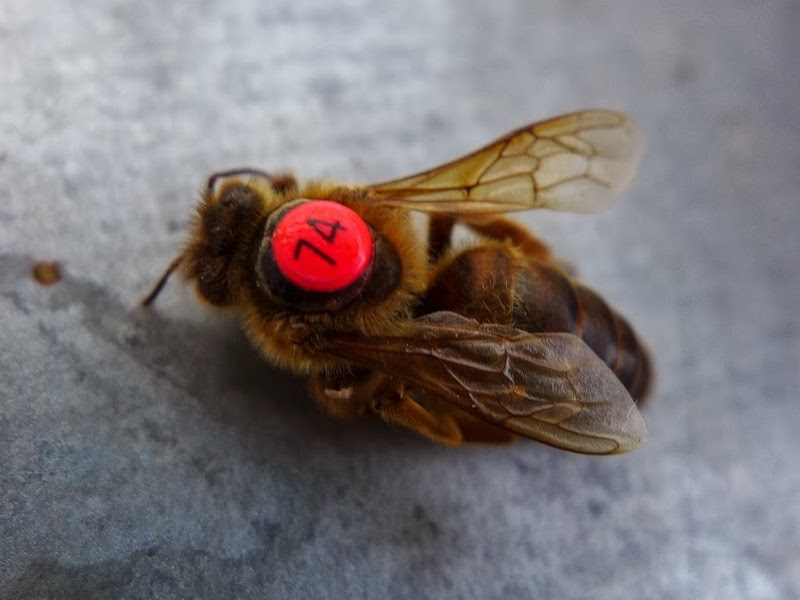
Will bees attack you if you kill their queen?
No. A honey bee colony will not deliberately attack you because you killed its queen.
Bees do not understand the event in the human sense or seek revenge. However, a queenless colony can become more agitated because the workers quickly detect that the queen’s pheromones are no longer present.
If you are manipulating a queenless hive, the bees may therefore appear noisier or more defensive than usual. But they are not attacking you specifically because you killed their queen.
What happens to the colony when the queen dies?
Worker bees can detect the loss of their queen relatively quickly.
The queen produces pheromones that circulate throughout the colony and help regulate its social organization. When those chemical signals disappear, the workers recognize that the colony is queenless.
If suitable young female larvae are available, the colony will normally begin an emergency response: the workers attempt to raise a new queen.
How do bees make a new queen?
Workers select very young female larvae and begin raising them as queens rather than workers.
They enlarge the cells into emergency queen cells and feed the developing larvae appropriately so that they develop into reproductive queens.
A queen develops from egg to adult in approximately 16 days.
Once a virgin queen emerges, she still needs time to mature, make mating flights and begin laying eggs. Under favorable conditions, it can therefore take several weeks after the loss of the old queen before the colony has a new laying queen.
What happens if several new queens emerge?
A colony may raise several emergency queen cells at the same time.
Usually, only one queen ultimately becomes established. Virgin queens may destroy rival queen cells or fight other emerged queens.
The surviving virgin queen then needs suitable weather and sexually mature drones in the area for successful mating flights.
This is one reason losing a queen at the wrong time of year can be much more serious than losing one during the normal reproductive season.
What if the colony cannot raise another queen?
The colony needs eggs or sufficiently young female larvae to produce an emergency queen.
If none are available, the workers cannot simply turn an older larva into a viable queen.
Without intervention from a beekeeper, a colony that remains queenless for an extended period can eventually develop laying workers. These workers can lay unfertilized eggs, which develop into drones rather than workers.
Without new worker brood, the colony population gradually declines and the colony will eventually fail.
What should a beekeeper do after accidentally killing the queen?
First, confirm that the colony is actually queenless.
If appropriate young brood is present and conditions are favorable, you can allow the colony to raise its own queen. But this process takes time and mating is not guaranteed.
Another option is to introduce a mated queen, which can significantly shorten the interruption in brood production.
The best choice depends on the season, colony strength, availability of drones and the beekeeper’s objectives.
Can a hive survive without its queen?
Temporarily, yes. Permanently, no.
A colony can continue functioning for some time after losing its queen because thousands of adult workers remain in the hive.
But without a successfully mated queen producing fertilized eggs, there will eventually be no new generation of workers to replace the aging bees.
The survival of the colony therefore depends on successfully raising or receiving a replacement queen.
What if you kill a queen bee in your house?
If you find a single queen bee inside your house, the situation is different from accidentally killing the queen during a hive inspection.
Queens normally spend their lives inside a colony, except during mating flights or when leaving with a swarm. Finding one alone indoors is unusual.
Killing a queen inside your house will not cause a colony of bees to come looking for you or attack you.
If a swarm or established colony is present in or around the building, however, removing the queen alone does not solve the underlying problem. The colony or swarm should be dealt with appropriately.
The key point
Accidentally killing a queen is a serious problem for a beekeeper, but it does not necessarily mean the colony is lost.
A healthy colony with suitable young brood can attempt to raise another queen. A beekeeper can also introduce a replacement queen.
And despite a surprisingly common question online: the colony will not attack you for killing its queen.