
What is a queen bee?
The queen bee is the primary reproductive female in a honey bee colony. A healthy colony normally has one queen, and her main role is to lay the eggs that produce the next generation of bees.
But the queen does more than lay eggs. Through pheromones, she also plays an important role in maintaining the social organization of the colony.
For a beekeeper, learning to recognize the queen and evaluate her performance is one of the fundamental skills of hive management.
What does a queen bee look like?
A queen bee looks different from both worker bees and drones.
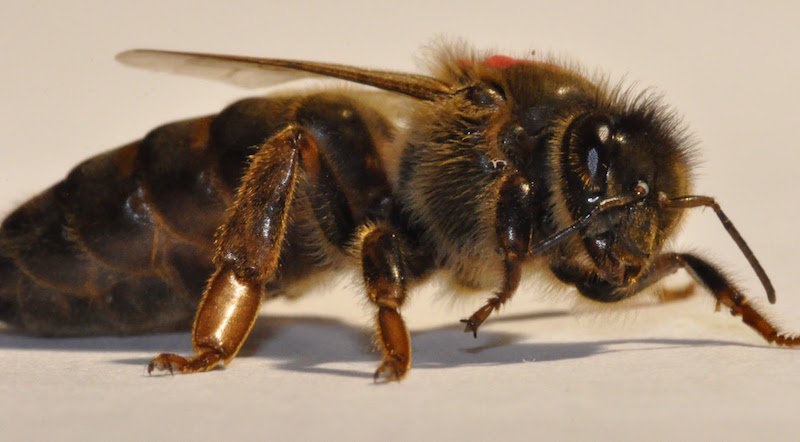
Her most recognizable feature is her long abdomen, which extends well beyond the tips of her wings. A mature laying queen is generally longer than the workers surrounding her.
When I look for a queen during an inspection, I don’t simply look for the largest bee. I look for the characteristic elongated abdomen and also watch the behavior of the workers around her.
Workers often create a small circle around the queen as she moves across the comb.
The photo on this page shows a real queen bee close up, allowing you to see the elongated abdomen that helps distinguish her from worker bees.
What does the queen bee do?
The queen’s primary role is reproduction.
During favorable conditions, a strong laying queen can produce a very large number of eggs each day. Her egg-laying rate changes according to the season, colony strength, available food and environmental conditions.
The queen also produces pheromones that influence the behavior and organization of the colony.
This chemical communication helps workers recognize that a functioning queen is present.
How does a queen become a queen?
Queens and worker bees both develop from fertilized eggs.
The difference comes from how the developing larva is raised and fed by worker bees. A larva selected to become a queen develops inside a special queen cell and receives intensive feeding during its development.
This produces a reproductive female with fully developed ovaries capable of laying eggs.
How does a queen bee mate?
A young virgin queen leaves the hive on mating flights.
She mates in the air with multiple drone bees, generally from different colonies. She stores sperm from these matings in an organ called the spermatheca and can use it to fertilize eggs throughout her reproductive life.
Mating with multiple drones contributes to the genetic diversity of the colony.
How can a beekeeper find the queen?
Finding the queen becomes easier with experience, but it isn’t always necessary to physically see her during every inspection.
I often look first for evidence that the queen is present and laying well.
Fresh eggs, young larvae and a consistent brood pattern can tell you a great deal about queen performance.
When looking directly for her, concentrate on brood frames, move slowly across the comb and look for the elongated abdomen rather than simply searching for a larger bee.
Some beekeepers mark their queens with a small colored dot to make them easier to identify.
How long does a queen bee live?
A queen can live for several years, considerably longer than a worker bee.
However, longevity and good performance are not the same thing.
For a beekeeper, what matters most is the queen’s ability to maintain a strong and consistent brood pattern. A queen may still be alive but no longer produce enough healthy brood for the colony.
This is why queen performance should be evaluated throughout the season rather than simply according to her age.
When should a beekeeper replace a queen?
There is no single rule that applies to every colony.
I consider the queen’s brood pattern, colony strength, temperament and overall performance when deciding whether replacement is necessary.
A declining brood pattern, repeated queen problems or poor colony development can indicate that requeening should be considered.
Genetics also matter. Selecting queens for desirable traits—including productivity, temperament and resistance to pests such as Varroa—is increasingly important in modern beekeeping.
The queen, workers and drones
A honey bee colony depends on three types of adult bees working together:
The queen provides reproduction and contributes to colony organization through pheromones.
Worker bees perform most of the work required to maintain the colony.
Drone bees are males whose primary biological role is mating with virgin queens.
Understanding the differences between these three types of bees makes it much easier to understand what is happening inside a hive during an inspection.