
Carniolan vs Italian bees: which is better?
Carniolan and Italian honey bees are two of the most popular choices among beekeepers. Both can produce strong, productive colonies, but they differ in brood development, swarming tendency, food consumption and adaptation to seasonal conditions.
Italian honey bees (Apis mellifera ligustica) originated in Italy and are known for their generally gentle temperament, strong brood production and large colony populations.
Carniolan honey bees (Apis mellifera carnica) originated in Central and southeastern Europe and are particularly known for adjusting their colony population rapidly according to environmental conditions.
Neither is universally “better.” The best choice depends on climate, forage, management style and—very importantly—the genetics of the particular queen.
Temperament
Both Italian and Carniolan bees are generally considered relatively gentle when they come from well-selected genetics.
Italian bees have become extremely popular partly because colonies are usually manageable and pleasant to work with.
Carniolans also have a strong reputation for docility.
However, temperament varies considerably between individual genetic lines. The quality and selection program of the queen breeder can matter as much as whether the bees are Italian or Carniolan.
Brood production
This is one of the most important differences between the two.
Italian bees tend to maintain larger brood populations for longer periods when conditions allow. This can create very strong colonies with large numbers of workers available for nectar collection.
The disadvantage is that a large population also consumes more food.
Carniolan bees generally respond more rapidly to changes in available forage. They can expand brood production quickly when resources become abundant and reduce brood production when resources decline.
This ability can be particularly useful in climates with strong seasonal changes.
Swarming
Carniolan bees have a reputation for building their populations very rapidly in spring.
That rapid expansion can also mean greater swarming pressure if the beekeeper does not provide enough space or monitor the colony carefully.
Italian colonies can swarm too, of course. Swarming is a natural reproductive behavior of honey bees and depends on colony strength, genetics, available space and environmental conditions.
Good management is therefore important with either type.
Honey production
Both Carniolan and Italian bees can be excellent honey producers.
Italian colonies often maintain large populations of foragers, which can be an advantage during long nectar flows.
Carniolans can build rapidly when a nectar flow begins, allowing them to take advantage of changing conditions.
In practice, honey production depends on much more than subspecies: weather, forage availability, colony health, queen quality and beekeeper management all have major effects.
Wintering and food consumption
Carniolan bees are particularly well known for regulating their colony population according to seasonal conditions.
By reducing brood production when resources become scarce, they can maintain a smaller winter population and conserve food stores.
Italian bees may continue brood production longer under favorable temperatures. Their larger populations can consequently consume more stored honey when forage is limited.
This difference is one reason Carniolans are often associated with colder or strongly seasonal climates.
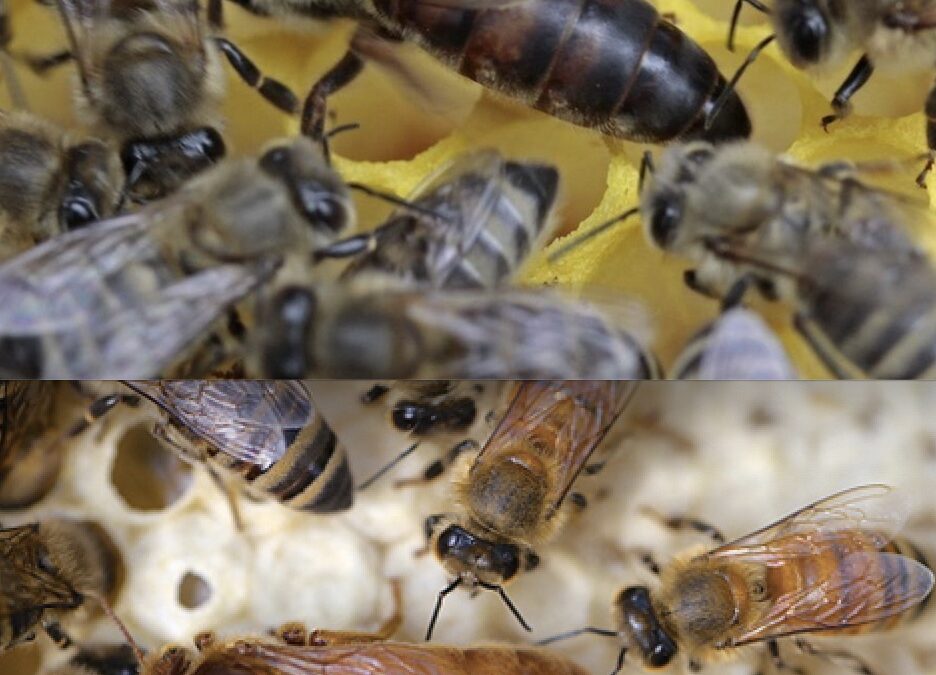
What do Carniolan and Italian bees look like?
There are visible differences, although appearance alone is not enough to determine genetics reliably.
Italian bees often show yellow or golden-brown bands on the abdomen.
Carniolan bees are generally darker, often gray-brown or dark brown, with lighter hairs giving them a somewhat silvery appearance.
There can be considerable variation within both populations, particularly because many managed honey bee populations contain mixed genetics.
Carniolan vs Italian queens
Choosing between a Carniolan queen and an Italian queen means choosing genetics that will influence the characteristics of the future worker population.
A new queen gradually changes the genetic composition of the colony as her daughters replace older workers.
For this reason, I pay more attention to the quality and selection of the queen’s genetics than simply to the name Italian or Carniolan.
What about Varroa resistance?
Neither Carniolan nor Italian bees should automatically be considered resistant to Varroa destructor.
Varroa resistance depends on specific behavioral and genetic traits that breeders can select for.
One example is VSH — Varroa Sensitive Hygiene. Bees expressing this trait can detect and remove brood in which Varroa mites are reproducing.
This distinction is important: an Italian queen can carry selected VSH genetics, just as resistance traits can be incorporated into other honey bee populations.
Why I use Italian VSH queens in California
In my own apiaries in the San Francisco Bay Area, I currently prefer Italian VSH queens.
Our Mediterranean-type climate allows colonies to remain active for long periods, making the brood-production characteristics of Italian bees well suited to my management.
But being Italian is only part of my selection.
I also want genetics selected for Varroa-sensitive hygiene, good brood patterns, manageable temperament and colony performance.
For me, choosing between Carniolan and Italian bees should therefore not simply be a question of breed. The better question is:
Which genetics are best suited to my climate, objectives and management system?