
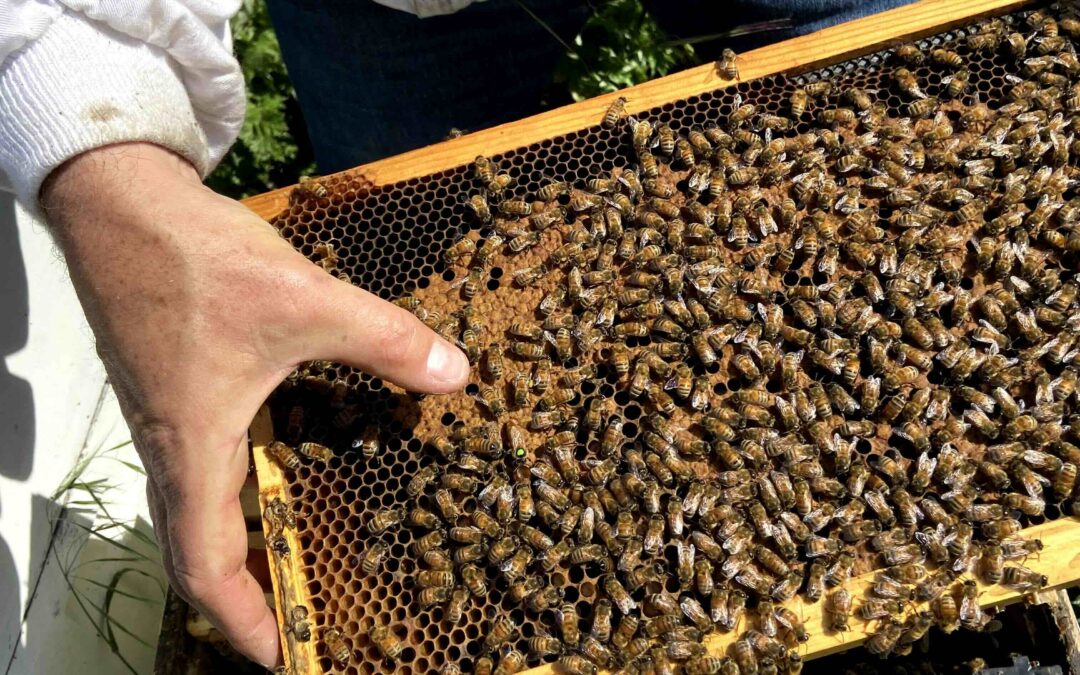
October is a critical month for beekeeping in the San Francisco Bay Area. As summer comes to an end, our priorities at Beeopic California are to complete our final Varroa treatments, support healthy brood production, and prepare our colonies for the slower months of November and December.
Unlike colder regions of the United States, Northern California has a Mediterranean climate, with mild winters and relatively little frost. Our honey bee colonies remain active throughout much of the winter, but their brood production follows a distinct seasonal cycle.
Understanding this cycle is essential for maintaining healthy colonies.
1. Complete the Final Varroa Treatments
Varroa destructor is one of the greatest threats to honey bee health.
During summer, Varroa populations can increase rapidly as colonies continue raising brood. By fall, high mite levels can weaken the bees that must sustain the colony through winter.
At Beeopic California, we use approved treatments, including Apiguard, a thymol-based product, to manage Varroa populations.
October is an important period for completing our fall treatments, provided temperatures and colony conditions are suitable and the product label is followed.
Our objective is to enter November with low Varroa levels and healthy colonies.
We also monitor mite levels after treatment to evaluate effectiveness.
Healthy winter colonies start with effective Varroa management in the fall.
2. The Last Pollen Patty of the Fall
In October, natural pollen availability often decreases in our apiaries around Brentwood and the East Bay.
Pollen is essential for brood development because it provides the proteins and nutrients needed to raise young bees.
At Beeopic California, we typically provide our last pollen patty of the fall in October.
The objective is to support healthy brood production before the seasonal slowdown.
Supplemental protein can help colonies maintain brood rearing when natural pollen is insufficient, provided they have adequate food reserves and healthy adult bees.
We do not try to maximize brood production at all costs. Instead, we want to ensure that nutritional shortages do not unnecessarily limit the development of healthy young bees.
These bees will help maintain colony strength during November and December.
3. Do California Honey Bees Stop Laying Eggs in Winter?
One of the most interesting aspects of beekeeping in the San Francisco Bay Area is our colonies’ winter brood cycle.
Based on our observations at Beeopic California, queens do not completely stop laying eggs during winter.
Instead, brood production gradually decreases during October and November as daylight hours shorten and natural pollen resources become scarce.
Then, the cycle begins to change.
With the arrival of winter rains, often in December, vegetation starts growing again, and fresh pollen gradually becomes available.
When weather conditions are favorable, this renewed pollen supply helps support an increase in brood production.
By December and January, our colonies often begin expanding their brood nests again.
This early development is particularly important for preparing strong colonies for almond pollination in February.
Our challenge is to maintain enough healthy bees through November and December to support this natural restart.
4. Why We Resume Pollen Patties in Mid-December
Our feeding strategy follows the natural rhythm of our colonies.
After providing the final fall pollen patty in October, we generally pause supplemental protein feeding during November unless colony conditions indicate a specific need.
Around mid-December, we resume providing pollen patties.
This second feeding period is designed to support the natural increase in brood production as winter progresses.
Our goal is not to force the colonies to develop prematurely but to ensure they have sufficient protein when brood rearing begins increasing again.
Of course, feeding decisions depend on colony strength, natural pollen availability, weather conditions, and food reserves.
Pollen patties supplement natural forage; they do not replace the need for adequate honey or carbohydrate reserves.
5. Preparing Colonies for November and December
Before November, we evaluate the overall condition of our colonies.
We focus on several essential factors:
- Varroa levels: ensuring treatments have been effective.
- Colony population: maintaining enough healthy adult bees.
- Queen performance: confirming that the queen is healthy and laying.
- Food reserves: checking that colonies have sufficient honey or stored carbohydrates.
- Nutrition: providing supplemental protein when natural pollen is insufficient.
Strong colonies entering November are better positioned to handle periods of cold, rain, and reduced foraging activity.
Because brood production may continue during winter in California, Varroa management remains particularly important.
Conclusion: Working With Our Mediterranean Climate
Beekeeping in Northern California requires a different approach from beekeeping in regions with long, freezing winters.
At Beeopic California, our fall management focuses on three priorities:
1. Complete Varroa treatments and verify their effectiveness.
2. Provide the last pollen patty in October to support healthy young bees.
3. Prepare for the natural increase in brood production by resuming protein supplementation around mid-December, when needed.
Our objective is simple: maintain healthy, well-populated colonies through November and December, ready to develop again as winter rains bring fresh vegetation and pollen.
The work we do in October helps determine the strength of our colonies for the following spring.
Beeopic California — Local Beekeeping in the San Francisco Bay Area.