
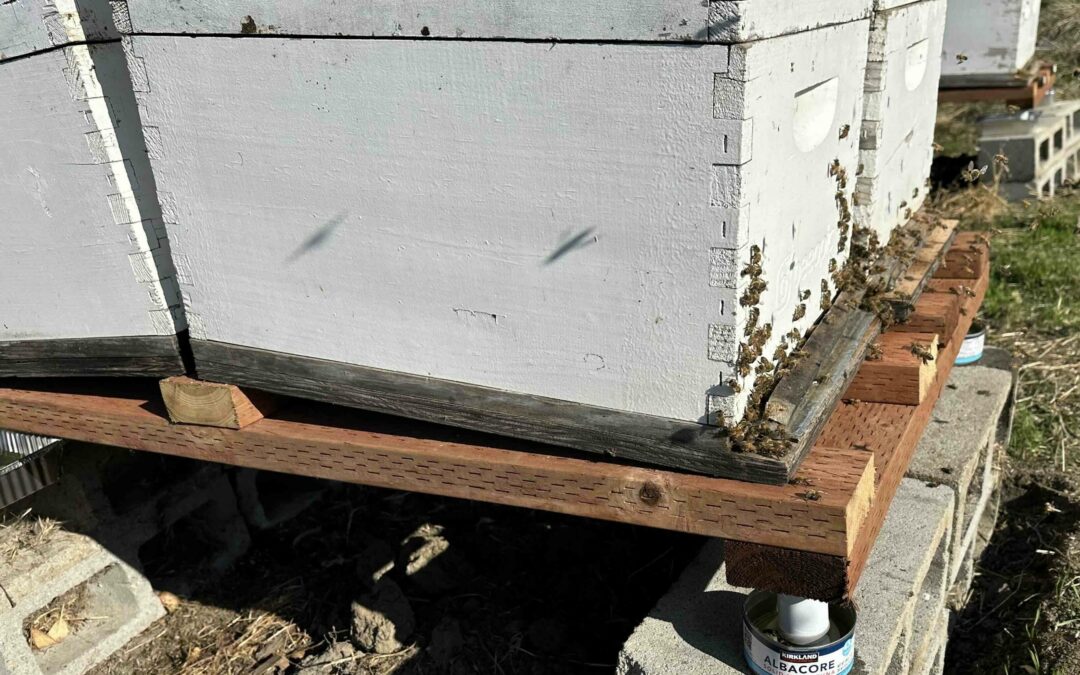
For the past few years, I have been dealing with Argentine ants invading my beehives in California. These ants are extremely small and can enter a hive in large numbers, especially when colonies have access to honey or supplemental feed.
I wanted a solution that would keep ants out of my hives without using insecticides around the bees.
The most effective method I have found is surprisingly simple: creating a physical barrier using vegetable oil.
Do ants harm beehives?
A strong honey bee colony can defend itself against many intruders, but Argentine ants are particularly difficult because of their small size and large numbers.
Ants can enter the hive looking for honey, syrup and other food. A persistent infestation can disturb the colony and becomes especially problematic around weaker colonies or feeding equipment.
Rather than trying to eliminate all the ants around an apiary, my approach is to prevent them from reaching the hive.
My solution: hive stands with an oil barrier
I built pallets that hold four hives. The pallets are supported by legs, similar to the legs of a bed frame.
Each leg stands inside a small container filled with vegetable oil.
The oil creates a physical barrier that the ants cannot cross, preventing them from climbing from the ground onto the pallet and into the hives.
This approach has worked very well in my California apiaries.
Why I use vegetable oil instead of insecticides
My objective isn’t necessarily to kill the ants. It is simply to keep them away from the bees.
By using a physical barrier, I avoid applying insecticides around the hive entrance or other places where honey bees may come into contact with them.
I use vegetable oil because the system is simple, inexpensive and effective. The important part is maintaining the barrier and making sure ants cannot reach the pallet through grass, branches or other objects.
Keep vegetation away from the hive stand
This is an important detail.
Even a perfect oil barrier becomes useless if tall grass or a branch touches the pallet. Argentine ants will quickly find another route to the hive.
I therefore keep vegetation away from the stands and regularly check that each pallet leg remains isolated from the ground.
My hive stand also helps with rain
I designed the pallet with a central support system that leaves the middle open.
This allows me to tilt the hives slightly forward during the rainy season so that water can drain toward the entrance rather than accumulate inside the hive.
The same stand therefore helps me manage both ants and moisture.
A simple approach that works in my apiaries
There are many ways to manage ants around beehives. This is simply the system that has worked best for me.
After dealing with Argentine ants in my California apiaries, I prefer prevention to trying to eliminate them: isolate the hive from the ground and prevent the ants from reaching it.
For my operation, a four-hive pallet with its legs protected by vegetable oil has proven to be a simple and effective solution.