
Honey bees have a remarkable sense of direction. A foraging bee can leave its hive, travel considerable distances to find flowers, and then return to the same colony with impressive accuracy.
Bees do not rely on a single navigation system. Instead, they combine several sources of information, including the position of the sun, polarized light, visual landmarks, odors and possibly the Earth’s magnetic field.
How Do Bees Navigate Using the Sun?
The sun is one of the most important navigational references for honey bees.
Bees can use the position of the sun as a compass and compensate for its movement across the sky during the day.
They can also detect patterns of polarized ultraviolet light, which helps them determine the sun’s position even when it is partially hidden by clouds.
This ability allows foraging bees to maintain a direction between the hive and a food source.
Bees Use Visual Landmarks
Honey bees also learn the landscape surrounding their hive.
Trees, buildings, hedges and other recognizable features can become visual landmarks that help bees navigate.
When young worker bees first begin flying, they perform orientation flights around the hive. During these flights, they learn the location of the colony and important features of the surrounding landscape.
This explains why moving a hive even a relatively short distance can initially confuse returning foragers: some bees may return to the location where they learned the hive was situated.
Can Bees Sense the Earth’s Magnetic Field?
Research suggests that honey bees may also be able to detect the Earth’s magnetic field.
Experiments have shown that changes in magnetic fields can influence some honey bee behaviors, suggesting that magnetoreception could provide an additional source of navigational information.
However, scientists are still studying exactly how honey bees detect magnetic fields and how important this sense is compared with visual and solar navigation.
It is therefore better to think of the magnetic field as one possible component of a much more complex navigation system.
Do Bees Use Smell to Navigate?
Smell is also important.
Honey bees have an extremely developed sense of smell, which helps them recognize flowers, identify their colony and communicate information about food sources.
Odors can therefore complement visual information when bees navigate through their environment.
How Do Bees Communicate Direction to Other Bees?
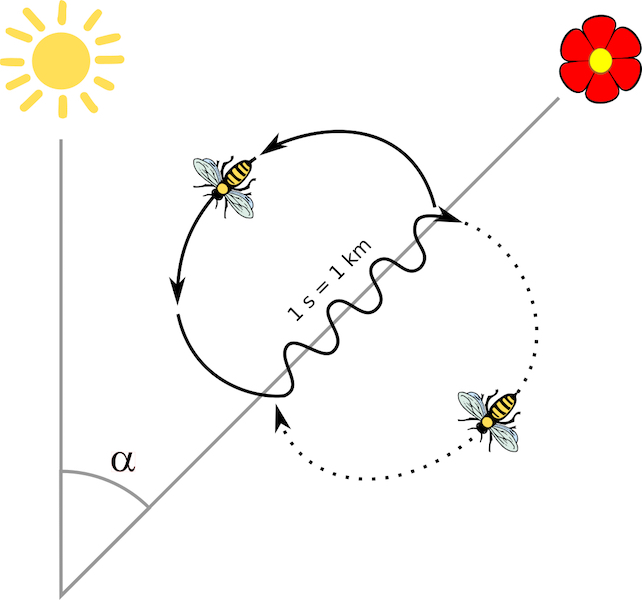
Navigation is closely connected to another remarkable honey bee behavior: the waggle dance.
A successful forager returning to the colony can communicate information about the direction and approximate distance of a food source.
The angle of the dance relative to gravity corresponds to the direction of the food source relative to the sun.
This discovery was famously studied by Karl von Frisch, whose research fundamentally changed our understanding of honey bee communication and navigation.
A Remarkable Navigation System
A honey bee does not navigate using one simple “GPS.”
Instead, it combines information from the sun, polarized light, landmarks, odors and potentially magnetic cues.
Together, these abilities allow a tiny insect to explore a large landscape and still find its way back to the hive.