
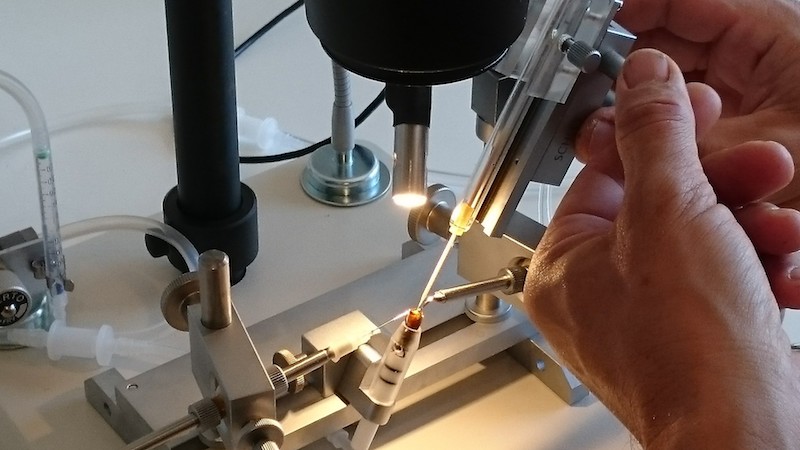
Artificial insemination of honey bee queens, more precisely called instrumental insemination, is a specialized breeding technique that allows beekeepers and researchers to control the genetic crosses between selected queens and drones.
Under natural conditions, a virgin queen mates in flight with multiple drones from surrounding colonies. The beekeeper therefore has limited control over the genetics of those drones.
Instrumental insemination changes this by allowing semen from specifically selected drones to be used to inseminate a selected queen.
Why Artificially Inseminate Queen Bees?
The primary purpose is genetic selection.
Controlled mating allows breeders to select and maintain specific characteristics such as:
- hygienic behavior;
- Varroa Sensitive Hygiene (VSH);
- temperament;
- productivity;
- wintering ability;
- resistance or tolerance to diseases and parasites.
This makes instrumental insemination particularly valuable in honey bee breeding and research programs.
How Does Queen Bee Artificial Insemination Work?
The process requires specialized equipment, training and considerable precision.
First, mature drones from selected colonies are used as the paternal genetic source. Semen is collected using specialized insemination equipment.
A young virgin queen from another selected genetic line is then carefully immobilized, and the collected semen is introduced into her reproductive tract using precision instruments under magnification.
After successful insemination, the queen is returned to a colony where she can begin laying fertilized eggs.
The objective is not simply to produce a laying queen. It is to create a controlled genetic cross whose parentage is known.
Why Is Controlled Mating Important in Honey Bee Genetics?
Honey bee breeding is complicated because queens normally mate in the air, often several miles from their colony, with drones from many different colonies.
This genetic diversity is beneficial to honey bee populations, but it makes controlled breeding difficult.
Instrumental insemination gives breeders much greater control over both the maternal and paternal genetics of a colony.
This allows specific traits to be evaluated and reproduced over multiple generations.
Artificial Insemination and Varroa Resistance
One of the most important applications of controlled honey bee breeding today is the selection of colonies that can better defend themselves against Varroa destructor.
Varroa Sensitive Hygiene, or VSH, is a behavioral trait in which worker bees detect and remove brood affected by reproducing Varroa mites.
Breeding programs can use controlled mating techniques to strengthen and stabilize these desirable traits across generations.
My Approach at Beeopic California
At Beeopic California, genetics are an important part of my Varroa management strategy.
I primarily work with Italian VSH queens, combining the characteristics of Italian honey bees with selected hygienic behavior.
For my production colonies, I work with specialized queen breeders rather than performing instrumental insemination myself. The objective is to introduce carefully selected genetics into colonies adapted to the conditions of the San Francisco Bay Area.
Read why I work with Italian VSH queens in the San Francisco Bay Area.