
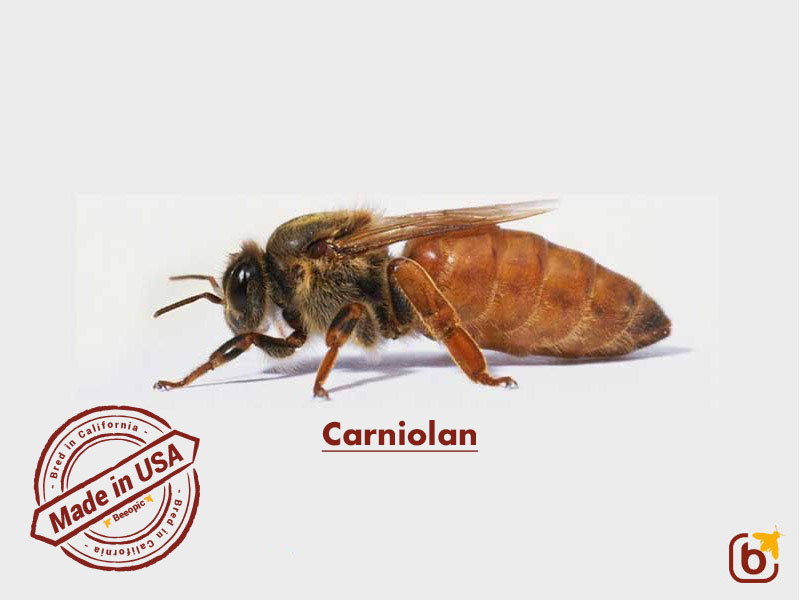
Carniolan honey bees (Apis mellifera carnica) are a subspecies of the Western honey bee. They originated in Central and Southeastern Europe, particularly Slovenia and the surrounding Alpine and Balkan regions.
Carniolan bees are popular with beekeepers because of their gentle temperament, strong spring development, efficient use of food stores, and ability to adapt their colony population to changing nectar and pollen availability.
What Do Carniolan Honey Bees Look Like?
Carniolan honey bees are generally darker than Italian honey bees. Workers typically have a gray to dark appearance, with bands of short, dense hairs that can give them a silvery-gray look.
They are sometimes called “gray bees” because of this characteristic appearance.
Why Are Carniolan Bees Popular With Beekeepers?
One of the main advantages of Carniolan bees is their gentle temperament. Well-managed colonies are generally calm on the comb and relatively easy to work.
They are also known for adjusting brood production quickly according to environmental conditions. When pollen and nectar become abundant in spring, a Carniolan queen can rapidly increase egg laying, allowing the colony population to expand quickly.
When forage becomes scarce, brood production tends to decrease. This helps the colony conserve honey stores during periods when little food is available.
Carniolan Bees and Swarming
Rapid spring buildup has an important drawback: Carniolan colonies can have a strong tendency to swarm when conditions are favorable.
Beekeepers working with Carniolan bees therefore need to monitor colony population, brood nest congestion and queen cells carefully during the spring.
Providing sufficient space at the right time is particularly important.
Carniolan vs. Italian Bees
Both Carniolan and Italian honey bees are widely used by beekeepers, but their colony development can be quite different.
Carniolan bees tend to adjust their population more closely to available forage and can develop extremely rapidly in spring. Italian bees generally maintain brood production for longer periods when conditions allow it.
For beekeepers, the best choice depends on climate, forage availability and management objectives.
[Read our detailed comparison of Carniolan and Italian bees.]
Are Carniolan Bees Right for Every Climate?
Not necessarily.
Carniolan bees developed in a European environment with relatively cold winters and strong seasonal changes. Their ability to reduce brood production when resources become scarce can be particularly useful under those conditions.
In climates with long, mild seasons, other genetics may be better suited to the beekeeper’s objectives.
At Beeopic California, for example, I primarily work with Italian VSH queens because they are well adapted to the Mediterranean climate of the San Francisco Bay Area and because Varroa resistance is an important part of my breeding strategy.