
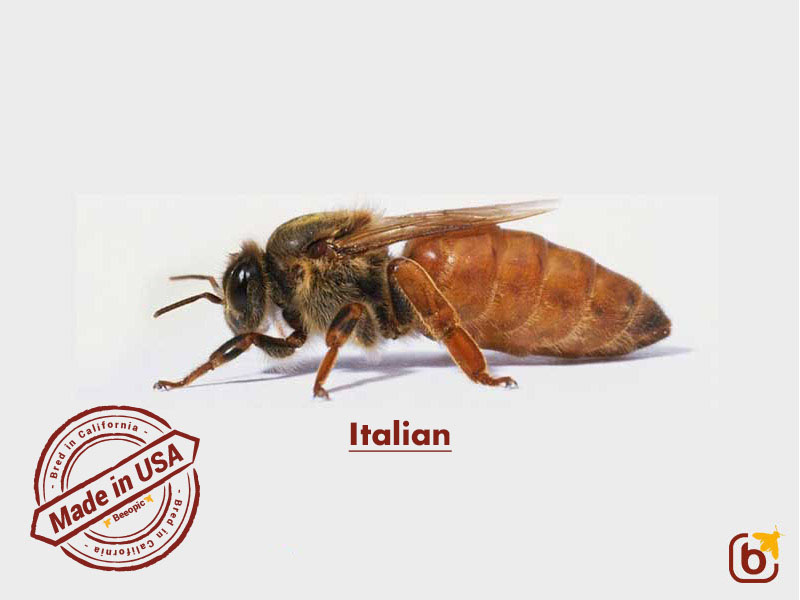
What are Italian honey bees?
Italian honey bees, scientifically known as Apis mellifera ligustica, are one of the most widely used types of honey bees in modern beekeeping.
They originated in Italy and have been introduced to many parts of the world because of characteristics that beekeepers value: generally gentle behavior, strong brood production and good honey production under favorable conditions.
I have worked with Italian bees for many years, and they are also the genetics I use in my California apiaries.
What do Italian bees look like?
Italian honey bees are often recognizable by their relatively light coloration.
Workers typically have yellow to golden-brown bands on their abdomen, although coloration can vary significantly between genetic lines. Some Italian bees are very yellow, while others appear considerably darker.
Color alone should therefore not be used to identify an Italian honey bee.
Italian queens can also vary considerably in color, from golden yellow to darker brown.
Why are Italian honey bees popular with beekeepers?
One of the main reasons Italian bees became so popular is their generally gentle temperament.
Gentle colonies are easier to inspect and manage, which is particularly valuable for new beekeepers and for operations where colonies are regularly handled.
Italian bees are also known for maintaining relatively large brood nests when resources are available. This allows colonies to build strong populations capable of taking advantage of nectar flows.
Are Italian bees good honey producers?
Italian honey bees can be excellent honey producers when forage conditions are favorable.
Their tendency to maintain large populations means that a strong colony can have many foragers available during a nectar flow.
But large populations also consume significant amounts of food. Good honey production therefore depends on the environment, colony management, weather and available forage—not simply on the genetics of the bees.
Advantages of Italian honey bees
From a beekeeper’s perspective, the principal advantages commonly associated with Italian bees include:
- Generally gentle temperament
- Strong brood production
- Large colony populations during the active season
- Good honey-production potential
- Relatively easy colony management
- Genetics widely available from queen breeders
These characteristics explain why Italian bees remain common in commercial and hobby beekeeping.
Disadvantages of Italian honey bees
Italian bees also have characteristics that require careful management.
Because colonies can maintain large brood nests and populations, they can consume significant food reserves when nectar becomes scarce.
In areas with long winters or extended periods without forage, this can become a disadvantage compared with bees that reduce brood production more aggressively.
Strong population growth can also contribute to swarming pressure if colonies become crowded and are not properly managed.
As with any honey bee stock, actual behavior varies considerably according to genetics, queen breeder, environment and management.
Italian bees and Varroa resistance
One important distinction is that “Italian” describes a honey bee subspecies, not Varroa resistance.
Italian bees are not automatically resistant to Varroa destructor.
This is why genetic selection matters.
In my California apiaries, I work with Italian VSH queens. VSH stands for Varroa Sensitive Hygiene, a behavioral trait selected to help colonies detect and remove brood affected by reproducing Varroa mites.
I see genetics as an important part of an integrated Varroa-management strategy rather than relying exclusively on treatments.
Why I use Italian bees in California
Italian bees are particularly interesting to me because of the conditions where I keep bees.
The San Francisco Bay Area has a Mediterranean-type climate, and Italian genetics have characteristics that work well with the long active seasons we experience in California.
Temperament is also important. I manage colonies regularly for beekeeping and pollination, so I value bees that combine productivity with manageable behavior.
Today, however, I don’t select queens simply because they are Italian. I also look at Varroa resistance, brood quality, temperament and overall colony performance.
For me, the future of beekeeping lies increasingly in combining proven honey bee genetics with careful selection for traits that help colonies remain healthy.