
August is an important transition month for beekeepers in the San Francisco Bay Area. The main spring and early-summer nectar flows are largely behind us, the landscape is becoming increasingly dry, and colonies are beginning to prepare for late summer and fall.
At Beeopic, our August management focuses on a few priorities: finishing the honey harvest, maintaining healthy brood production, monitoring Varroa, checking food reserves, controlling ants, and making sure colonies remain strong going into September.
Here is what we look for in our hives during August.
1. Finish the Honey Harvest
In our area, the main honey harvest should normally have been completed in July.
If you still have honey supers that need to be harvested, don’t wait too long. August conditions in the Bay Area are generally much drier, and the major nectar flows have largely finished.
Once the harvest is complete, we can concentrate entirely on preparing the colony for the second half of the year.
When removing honey, always make sure the bees retain sufficient stores for themselves. The objective is not to remove every available frame of honey.
2. Support Brood Production with Protein When Needed
August brood production matters more than it may appear.
The bees raised during late summer will help maintain colony strength through September and into the fall. But by August, natural pollen availability can become more limited in many parts of the Bay Area.
In our apiaries, we use pollen patties in August to provide additional protein when natural resources are insufficient.
This can help support brood rearing and encourage the colony to maintain a healthy brood nest during this dry period.
Without adequate protein coming into the hive, brood production can decline significantly. A colony that becomes too weak in August may enter September with fewer young bees than we want.
The goal is not to force unnaturally high brood production. It is to make sure that a lack of available pollen does not unnecessarily limit the colony.
3. Check the Queen and Brood Pattern
August is a good time to look carefully at the brood nest.
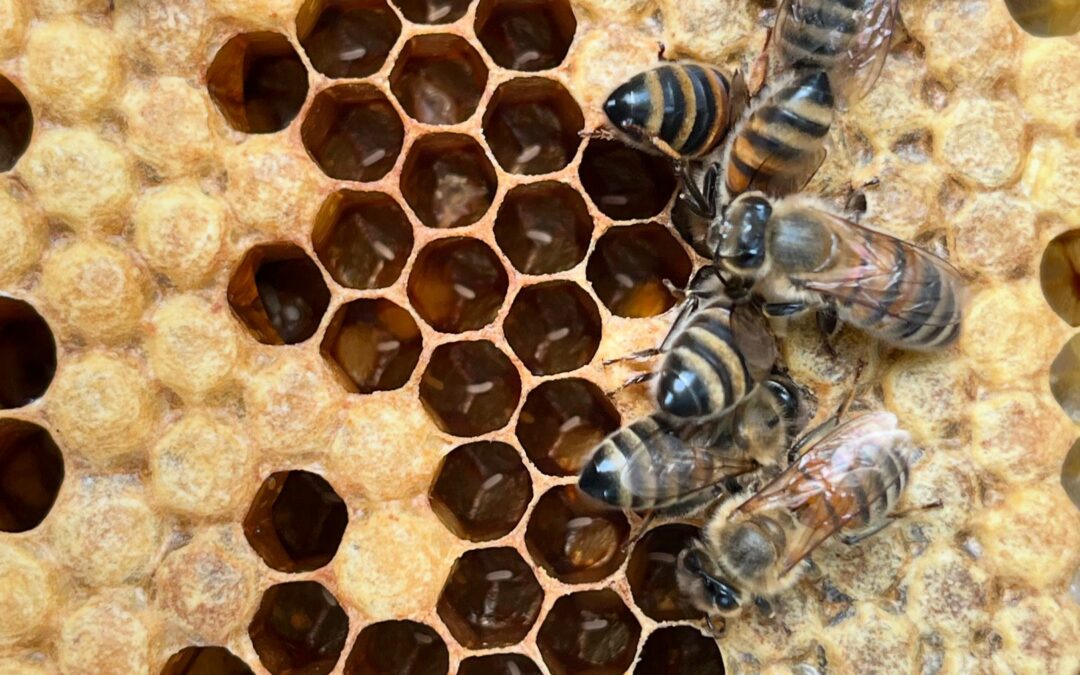
We want to see a functioning queen, eggs and larvae of different ages, and a reasonably consistent brood pattern.
Brood areas will naturally change as summer progresses, so a smaller brood nest does not automatically indicate a problem.
What matters is understanding why brood production is declining.
Is it simply the normal seasonal slowdown? Is pollen becoming scarce? Is the colony short of food? Is Varroa pressure increasing? Or is the queen beginning to fail?
Finding the cause in August gives you time to react before fall.
4. Monitor Varroa Carefully
Varroa should be one of your major concerns at this time of year.
The dangerous combination is simple: the bee population begins to decline after the main season while the mite population can remain high.
That means the number of mites relative to the number of bees can increase rapidly.
Don’t judge Varroa levels simply by looking at the bees. Use a proper monitoring method and know the mite pressure in your colonies.
Treatment decisions should be based on actual mite levels, colony conditions and the treatment method being used.
Strong-looking colonies in August can deteriorate surprisingly quickly when Varroa pressure is allowed to become too high.
5. Check Honey and Food Reserves
After harvesting, check what remains in the hive.
August in the Bay Area can be hot and dry, and natural forage varies considerably depending on the exact location of the apiary.
Some colonies will have plenty of stores. Others may consume their reserves faster than expected.
Lift the hive, inspect the food frames and learn to recognize the weight of a colony with adequate stores.
Feed carbohydrates only when the colony actually needs them. There is little benefit in automatically feeding syrup to a colony that already has sufficient honey.
Protein availability and carbohydrate reserves are two different issues and should be evaluated separately.
6. Watch for Ant Pressure
Ants can become particularly troublesome during the dry California summer.
Argentine ants are a persistent problem in many Bay Area apiaries. Once they establish trails into a hive, they can put considerable pressure on a colony, especially a weaker one.
Inspect hive stands and pallets for ant activity.
In our apiaries, we use a physical barrier system rather than chemicals around the hives: our pallets are supported on legs placed in containers with vegetable oil. This prevents ants from climbing from the ground onto the pallet and into the colonies.
Whatever system you use, August is not the month to ignore ants.
7. Identify Weak Colonies Before Fall
August is also a good month to compare colonies.
Which colonies have good populations?
Which have healthy brood?
Which queens are performing well?
Which colonies are noticeably weaker than their neighbors?
Don’t wait until late fall to discover that a colony has been declining for months.
A weak colony in August still gives the beekeeper time to investigate the cause and decide what action is appropriate.
8. Start Thinking About September
The decisions we make in August affect the colonies we will have in September and fall.
Our objective is straightforward:
healthy colonies, controlled Varroa levels, adequate food reserves, active queens and enough young bees.
August is therefore not a quiet month after the honey harvest. It is a transition month.
Spring management is about building colonies and taking advantage of the nectar flow.
Late-summer management is about protecting the strength we have built.
For beekeepers in the San Francisco Bay Area, paying attention to brood, protein, Varroa, food reserves and ants during August can make a major difference in how colonies enter the fall.