
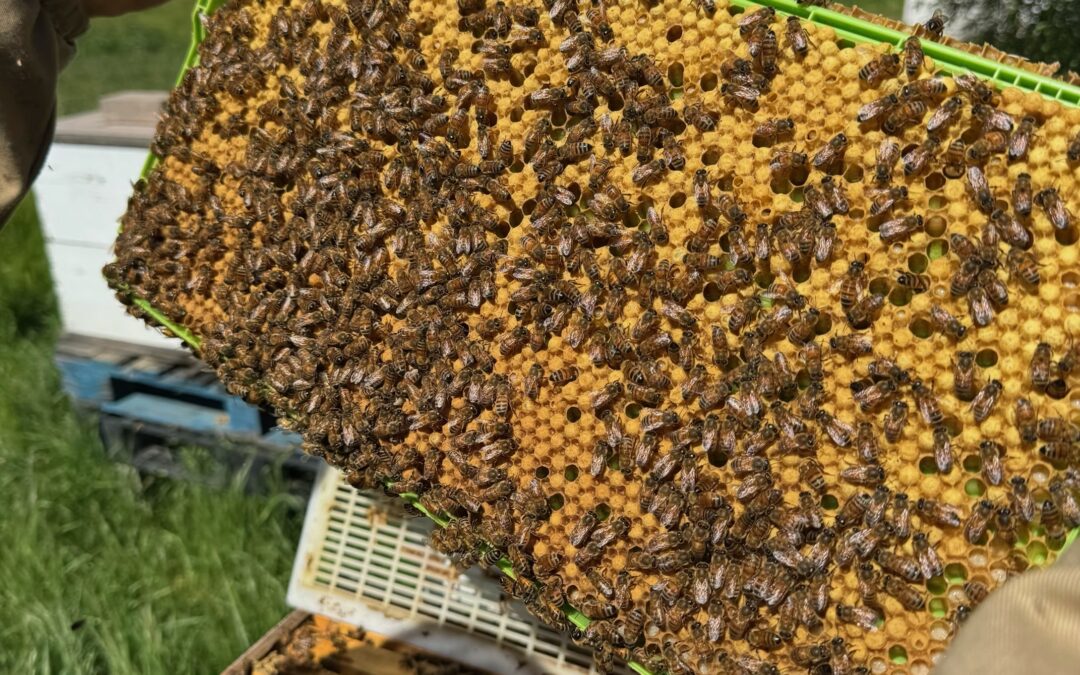
Drone brood trapping is a chemical-free method that beekeepers can use to help reduce the number of Varroa mites (Varroa destructor) in a honey bee colony.
The method takes advantage of an important part of Varroa biology: Varroa mites reproduce more successfully in drone brood than in worker brood because drone brood remains capped longer.
By encouraging the colony to produce drone brood and removing it after the cells are capped—but before the adult drones emerge—a beekeeper can physically remove many reproducing mites from the colony.
How Does a Varroa Mite Trap Work?
A drone brood frame contains larger cells that encourage the queen to lay unfertilized eggs that develop into drones.
When mature female Varroa mites enter these cells shortly before capping, they reproduce inside the sealed brood cells.
The beekeeper then removes the capped drone brood before the drones emerge. The mites reproducing inside those cells are removed with the brood.
This technique is generally called drone brood removal or drone brood trapping.
How to Use a Drone Frame for Varroa Control
1. Place a drone frame in the brood nest
Place the drone frame near the edge of the brood area, where the colony can draw the comb and the queen can lay drone eggs.
2. Allow the queen to lay drone brood
During periods of active colony growth, the bees will usually draw drone-sized cells and the queen will begin laying in them.
3. Wait until the drone brood is capped
Varroa mites enter brood cells before they are capped. Once the drone brood is capped, reproducing mites are trapped inside the cells.
4. Remove the frame before the drones emerge
This is the critical step.
If the drones are allowed to emerge, the Varroa mites developing inside the cells will also return to the colony.
5. Freeze the frame
Place the capped drone brood frame in a freezer for at least 24 hours. This kills the drone brood and the Varroa mites inside the capped cells.
6. Return the frame to the colony
After freezing, the frame can be returned to the hive. Worker bees will clean out the dead brood, allowing the process to begin again.
When Should You Use Drone Brood Trapping?
Drone brood trapping works best during periods when colonies are naturally producing drones, generally during spring and early summer.
It becomes much less useful when colonies stop producing significant amounts of drone brood.
Timing therefore depends on the local climate and colony development.
Can Drone Brood Removal Control Varroa by Itself?
Usually, no.
Drone brood removal can help reduce mite reproduction, but it should be considered part of an Integrated Pest Management (IPM) strategy rather than a complete Varroa treatment program.
Beekeepers should continue to monitor mite levels and use additional control methods when necessary.
At Beeopic California, Varroa management also includes an important genetic component. I work primarily with Italian VSH queens, selected for Varroa Sensitive Hygiene behavior, as part of my strategy for maintaining healthier colonies.